

How to Lower Energy Costs in Commercial Cold Storage

The global cold chain is currently experiencing a period of unprecedented expansion. Driven by shifting consumer habits, the rapid growth of online grocery deliveries, and the increasing demand for temperature-sensitive pharmaceuticals. Recent market growth analyses highlight this massive upward trajectory, pointing to a future where temperature-controlled logistics form the critical backbone of global supply chains [1].
However, this rapid industrial expansion brings with it a severe operational challenge. For operators within the UK and global cold chain, the cost of doing business is rising at an alarming rate. With recent and sustained hikes in commercial energy prices, electricity has firmly cemented its position as one of the most significant operational expenses for any temperature-controlled facility, frequently second only to labour and transport costs. The pressure to maintain profitability while safeguarding expanding temperature-sensitive inventories has never been more intense, forcing facility managers to scrutinise every single aspect of their operations.
When managing a large-scale frozen distribution centre or a regional cold store, the energy consumption figures quickly add up to staggering sums. According to benchmarking data from the Cold Chain Federation, the refrigeration plant is the undisputed heavyweight of power consumption, typically responsible for the vast majority of a facility's total energy footprint [2]. While modern, purpose-built facilities are constantly striving for a lower Specific Energy Consumption (SEC) through better insulation and efficient LED lighting, the fundamental energy draw of heavy refrigeration remains immense.
However, as the UK and global energy landscape evolves, the core issue is no longer simply how much energy a facility uses, but crucially, when it uses it. This is where peak energy tariffs become a critical financial challenge for cold storage operators, and where thermal energy storage is rapidly emerging as the ultimate, future-proof solution.
The Peak Tariff Penalty
The UK and global energy grids generally operate on a delicate supply-and-demand basis, leading to the widespread implementation of Time of Use (ToU) tariffs. These dynamic pricing structures are designed to reflect the physical strain on the grid at any given moment. During off-peak hours, typically overnight, electricity is abundant, commercial demand is low and prices are highly competitive. Conversely, during the day, particularly in the late afternoon and early evening when commercial operations and residential demand overlap, national grid capacity is pushed to its absolute limits and electricity prices soar to their highest levels.
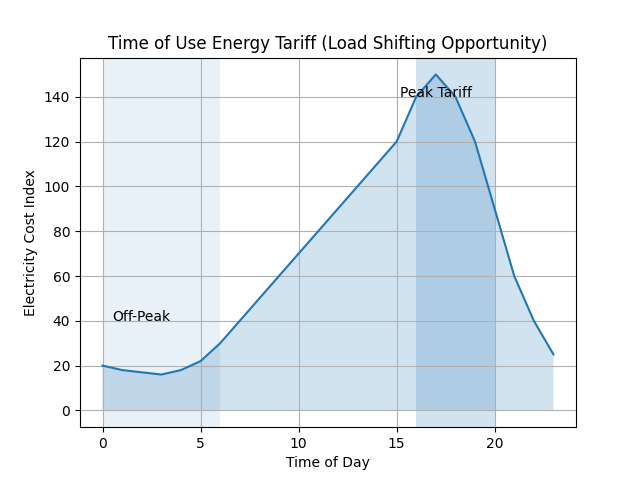
For many traditional manufacturing industries, mitigating these increasing costs involves a straightforward strategy: simply shifting production schedules, running heavy machinery at night, or turning off non-essential equipment during the afternoon. However, for a frozen cold storage facility operating at a strict -18°C, this has historically been impossible.
Heat naturally travels from hot environments to cold ones. To maintain a constant state of thermal disequilibrium, commercial refrigeration plants must operate continuously. Every time a warehouse door opens for a forklift, warm, moist air floods into the sub-zero environment. Even with high-speed doors and heavy panel insulation, heat continually permeates the thermal envelope. The refrigeration plant must immediately ramp up its compressors to extract this heat and protect the inventory.
If a facility attempts to power down its compressors during the most expensive peak tariff hours, the internal temperature will inevitably begin to rise. This jeopardises product integrity, risks catastrophic spoilage, and potentially violates strict cold chain compliance regulations. Consequently, cold store operators have been forced into a corner: they must run their most energy-intensive equipment at the exact time when electricity is at its most expensive. They are trapped paying a premium simply to maintain the status quo.
The Thermodynamic Dilemma
This dynamic creates a profound thermodynamic dilemma. Facility managers desperately want to reduce their peak power demand to save money, but they cannot afford to compromise on temperature stability.
Historically, the only ways to achieve efficiency gains were through marginal, incremental improvements. Operators might upgrade to slightly more efficient compressors, optimise condenser fan speeds with variable frequency drives, or rely on the physical thermal mass of the frozen product itself to buffer slight temperature rises. While these strategies are helpful and represent good engineering practice, they are fundamentally limited. They do not allow a facility to completely power down its main plant during peak hours without putting stock at risk.
To truly decouple cooling demand from peak energy tariffs, operators need a radical shift in how they manage thermal energy. They need a way to harvest and store cold energy when it is cheap, and deploy it when energy is prohibitively expensive. In short, they need a thermal battery.
Enter Phase Change Materials (PCM)
The solution to the peak tariff problem lies in the direct application of Phase Change Materials (PCM).
PCMs are engineered chemical substances specifically designed to store and release massive amounts of thermal energy during the process of changing physical state, typically from a solid to a liquid, and vice versa. It relies on the exact same fundamental principle as an ice cube melting in a glass of water, absorbing heat to keep the drink cool, but it is engineered to melt and freeze at different temperatures, hence allowing for application across a multitude of commercial and industrial applications.
When a Phase Change Material freezes, it absorbs and stores a vast amount of cooling energy in the form of latent heat. Because this phase change occurs at a nearly constant temperature, PCMs can store highly concentrated thermal energy within a remarkably small footprint compared to standard sensible heat storage. Recent peer-reviewed scientific studies and engineering journals validate that deploying PCM within cold storage environments significantly enhances thermal stability and unlocks advanced load-shifting capabilities [3].
To put this into perspective, the heat of fusion required to freeze water into ice is over eighty times larger than the sensible heat required to simply lower the temperature of liquid water by a single degree. When this scientific principle is applied using specialised chemical formulations designed to freeze at exactly -18°C, -25°C, or other critical cold chain temperature ranges, it transforms from a laboratory concept into a powerful industrial tool.
At Glacier Storage, we utilise these advanced materials to create passive thermal batteries specifically designed for the rigorous demands of the cold chain. By packaging precisely engineered PCM into robust, modular solutions like the GlacierCore™ drop-in tubes, we allow facilities to radically alter their energy consumption profile. Because these modules are designed to integrate seamlessly into existing pallet racking, facilities can add massive thermal capacity without altering their physical footprint or sacrificing a single pallet space of valuable storage.
Load Shifting: The Strategy for Massive Savings
Integrating a PCM thermal battery into a cold storage facility unlocks the strategy of "load shifting." This is the highly effective practice of moving your heaviest energy consumption away from peak hours and into cheaper off-peak windows. It fundamentally changes the facility's relationship with the electrical grid.
Here is a detailed breakdown of how the load shifting process works in a modern frozen cold store:
1. The Charge Phase (Off-Peak)
During the night, when electricity tariffs are at their absolute lowest, the facility runs its refrigeration equipment. The cold air circulated by the supply fans is used to actively freeze the PCM modules installed directly within the warehouse racking. Because the electricity is cheap, the facility can afford to run its compressors at full capacity, thoroughly "charging" the thermal battery with cold energy.
2. The Discharge Phase (Peak Tariff)
As the day progresses, the electrical grid experiences heavier loads from commercial businesses and residential homes. Consequently, energy prices begin to peak. At this exact moment, the cold storage facility takes a step that would normally be impossible: it turns its heavy refrigeration equipment down, or in many cases, powers it off entirely for certain periods.
Instead of the compressors working at full load to remove infiltrated heat, the frozen PCM modules passively absorb that heat. The thermal battery slowly discharges, maintaining a highly stable, strictly controlled room temperature while consuming absolutely zero electricity.
[Graph Placeholder: Dual-axis chart showing 'Compressor kW' dropping significantly during the daytime hours, while the corresponding 'Room Temperature' line remains perfectly flat and stable]
By absorbing the ambient heat, the PCM acts as a massive thermal buffer. Once the peak tariff window has passed and energy prices drop back down to an acceptable level, the automated refrigeration plant kicks back in. It brings the room down to its lowest set point and begins recharging the PCM modules, ready for the next day's cycle.
Beyond the Tariff: The Hidden Operational Efficiencies
While bypassing expensive daytime electricity is the primary financial driver for load shifting, thermal energy storage delivers a cascade of secondary benefits that further reduce the total cost of ownership and improve facility operations.
Exploiting Cooler Night Air for Condenser Efficiency
Refrigeration systems reject heat into the outside atmosphere via external condensers. During the day, ambient air temperatures are significantly higher, meaning the compressors have to work much harder to reject the heat. By shifting the primary cooling load to the night, the plant operates when ambient temperatures are naturally cooler. This day-to-night temperature differential directly improves condenser performance and overall compressor efficiency. You actually use fewer total kilowatts to generate the same amount of cooling capacity simply because the external air is colder.
Reduced Defrost Penalties
Every time warm air enters a cold store, moisture is introduced. This moisture eventually forms frost on the evaporator coils, restricting airflow and reducing efficiency. Removing this frost requires highly energy-intensive defrost cycles, which introduce unwanted heat back into the room. Because PCM modules offer a significantly increased thermal capacity compared to the stored product alone, they absorb a massive portion of the infiltrated heat and moisture. Consequently, facilities often see a dramatic reduction in the frequency and duration of required defrost penalties, saving further energy.
Equipment Longevity and Reduced Maintenance
Compressors endure the most mechanical wear and tear during short-cycling, whereby the equipment turns on and off rapidly to maintain a tight temperature set point. The immense thermal buffer provided by the PCM smooths out the temperature profile of the room. This allows compressors to run in longer, highly efficient continuous cycles during the night, and rest more often, if not entirely during the day. This drastically reduces mechanical strain, lowering ongoing maintenance costs and significantly extending the lifespan of your core refrigeration equipment.
Real-World Impact: The West Midlands Data
The theoretical benefits of Phase Change Materials are undeniably compelling, but the real-world data is what truly matters to facility managers, operations directors, and finance teams.
Recent independent monitoring at a commercial frozen cold store in the West Midlands, UK, perfectly demonstrated the financial power of this technology. The facility, operating at -18°C, sought to mitigate its severe daytime power spikes. After seamlessly retrofitting 22 GlacierCore™ drop-in modules into their existing racking infrastructure to act as a thermal battery, the facility was able to actively shift its heavy cooling load.
The monitored results over a five-month period were immediate and transformative. The site achieved a 17.43 percent reduction in peak power demand, successfully dropping their maximum draw from 109 kW down to a highly manageable 90 kW.
More impressively, by successfully shifting their primary refrigeration load away from the punishing daytime tariffs, they cut their direct operational freezer costs by 38 percent. This translated to an estimated financial saving of £905 per month on freezer running costs alone. The overall efficiency gains also resulted in a 35 percent peak reduction in freezer kWh consumption during testing, contributing to a whole-site energy saving of 4.60 percent.
Crucially, product integrity was never compromised. Even with the main plant regularly powered down to avoid the peak pricing windows, the facility recorded an incredible 48 percent improvement in temperature stability. The passive thermal battery proved it could protect the product inventory far better than continuous mechanical cooling, achieving a remarkable system payback period of just 1.5 years.
The Future of Cold Storage is Flexible
As the cold chain continues to expand globally and the UK energy grid incorporates more intermittent renewable energy sources, the push for industrial sustainability and demand-side response will only accelerate. Energy flexibility will soon transition from a competitive advantage to an absolute operational requirement. Cold storage operators can no longer afford to be entirely at the mercy of volatile energy markets and punishing peak tariffs.
Phase Change Material technology offers a proven, highly accurate, and zero-maintenance pathway to true energy autonomy. By transforming a static warehouse into a dynamic, intelligent thermal battery, operators can finally decouple their cooling requirements from the grid's most expensive hours.
Slashing peak energy tariffs is no longer an engineering fantasy or a concept restricted to academic papers; it is a practical, highly profitable reality. It allows the cold chain to protect its margins, protect its inventory, and build a more resilient, sustainable future, achieved simply by working smarter, not harder.
References:
1. Yahoo Finance, 2024. Cold Storage Market Growth Analysis. Available at: https://uk.finance.yahoo.com/news/cold-storage-market-growth-analysis-080600834.html
2. Cold Chain Federation, 2024. Cold Chain Energy Benchmarking. Available at: https://www.coldchainfederation.org.uk/cold-chain-energy-benchmarking/
3. ScienceDirect, 2025. Research Article: Application of Phase Change Materials in Cold Storage Systems. Available at: https://www.sciencedirect.com/science/article/pii/S2352152X25000520


